

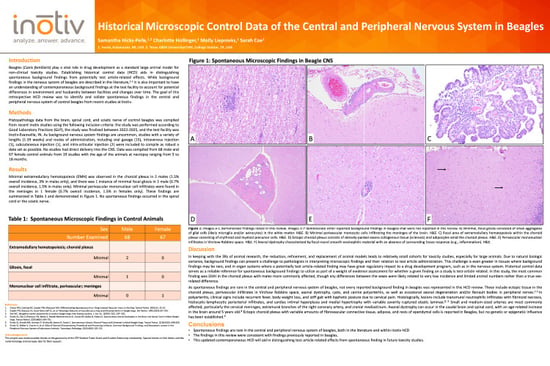
Evaluate spontaneous CNS findings in control canines.
Background neurologic findings in canines are uncommon, yet even minimal lesions can complicate interpretation in toxicity studies. Updated historical control data (HCD) help pathologists distinguish spontaneous changes from potential test‑article effects.
This retrospective review compiled brain, spinal cord, and sciatic nerve data from 135 control canines across 19 GLP studies. Findings were rare and minimal, with no spontaneous lesions in the spinal cord or peripheral nerve.
This study demonstrates how contemporaneous HCD support confident interpretation of neurologic findings in large‑animal safety studies.
What You’ll Learn from This Scientific Poster:
-
How often spontaneous CNS findings occur in modern canine colonies
-
How to differentiate minimal background lesions from potential test-article effects
-
Why updated, facility-specific HCD strengthen weight-of-evidence assessments
-
How rare CNS findings impact regulatory interpretation
Download the Scientific Poster to explore how updated canine CNS HCD support neurologic safety assessment.